Downsizing, decluttering, or staying put? Housing choices later in life - part 2
Categories: retirement
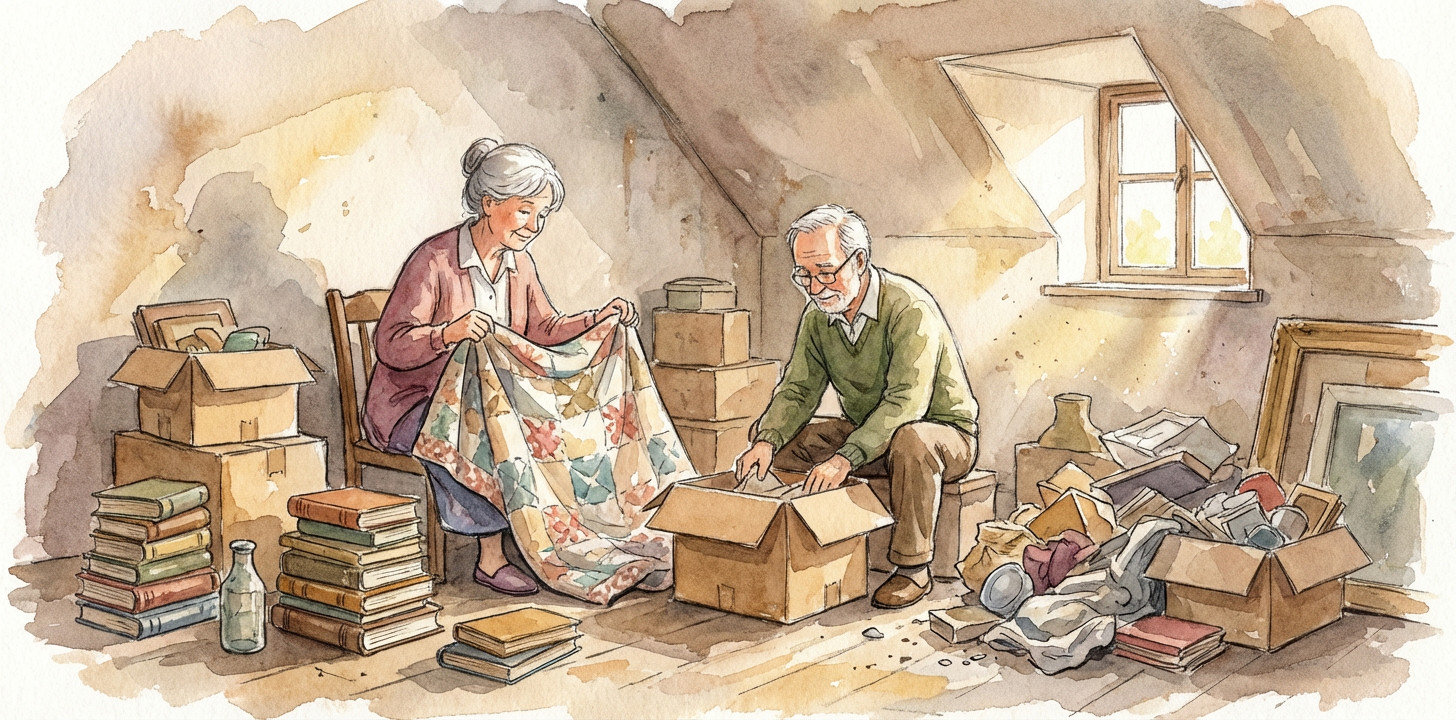
This series looks at how our housing needs change as we get older and offers common strategies for dealing with those changes. In the previous article in this series, we looked at downsizing. This time, we will look at an alternative approach - decluttering.
This article is intended for informational purposes and does not constitute financial, legal, or medical advice. Readers are encouraged to consult qualified professionals when making housing, financial, and healthcare decisions.
The Philosophy Behind Decluttering
Not every housing problem requires a new house. For many older adults, the issue is not so much that their home is the wrong size but that decades of accumulation have made it feel overwhelming, unsafe, or unmanageable. Decluttering, if done thoughtfully and thoroughly, can transform a familiar home into one that feels spacious, functional, and ready for the years ahead. It is often the ideal middle path: retaining the comfort and attachment of a beloved home while addressing the practical realities of ageing.
The concept of intentional decluttering has entered mainstream culture through figures like Marie Kondo, whose "KonMari" method asks people to keep only items that "spark joy". You might also have heard of the Swedish tradition of döstädning (which literally translates as "death cleaning"). This is a pragmatic, unsentimental approach in which older adults systematically reduce their possessions so that the burden does not fall on their families after they are gone. While neither philosophy needs to be adopted wholesale, both offer useful frameworks for approaching what can otherwise feel like an impossibly large task.
If you are in the UK, you might also have watched the BBC series Sort Out Your Life, which covers decluttering for all age groups.
At its deepest level, decluttering in later life is about creating an environment that supports who you are now and who you may become in the years ahead, rather than serving as a museum to who you once were. It is about clearing space, physically, cognitively, and emotionally, for the present.
Physical and Psychological Benefits
The benefits of a serious declutter extend far beyond aesthetics. From a safety perspective, clutter is one of the leading contributors to falls among older adults, and falls are the number one cause of injury-related death among people in the UK aged over 65. Piles of newspapers, stacked boxes, extension cords snaking across floors, and crowded hallways are not just untidy, they are hazards. Clearing these obstacles is one of the simplest and most effective things an older adult can do to protect themselves.
The psychological benefits are equally significant. Research in environmental psychology has consistently shown that cluttered environments increase cortisol (the body's primary stress hormone) and decrease the ability to focus and make decisions. People who live in cluttered homes report lower life satisfaction and higher levels of anxiety and depression. Conversely, a well-organised, uncluttered space promotes a sense of calm, control, and mental clarity that is particularly valuable during the transitions and uncertainties of later life.
There are practical caregiving benefits as well. If the time comes when an in-home helper, visiting nurse, or physical therapist needs to work in your home, a decluttered space makes their job immeasurably easier, which in turn can make the care you receive more effective. A wheelchair or walker requires clear, wide pathways. A caregiver assisting with bathing needs an uncluttered bathroom. These are not hypothetical concerns for anyone planning to age in place.
Perhaps most meaningfully, the process of decluttering offers an opportunity for intentional legacy work. Nobody wants to leave their children and grandchildren with the task of sorting out a house full of unlabeled boxes after a funeral. Such a task is both emotionally draining and logistically exhausting. Instead, you might choose to distribute meaningful items now, accompanied by the stories and context that give them value. A set of china means more when it comes with the story of where it was purchased and why it mattered. A piece of jewellery carries greater weight when it is given in person, with love, rather than discovered in a drawer.
A Room-by-Room Strategy
The most effective way to approach a whole-house declutter is to break it into smaller, manageable tasks. An obvious way to tackle this is on a room-by-room basis. Trying to do everything at once almost always leads to overwhelm and abandonment.
The kitchen is often a rewarding place to start because the decisions tend to be relatively straightforward. Most kitchens accumulate duplicate gadgets, expired pantry staples, speciality appliances used once and forgotten, stacks of takeout containers, and chipped dishes that serve no purpose. Honestly, if you own three can openers, two will never be missed. If that bread maker hasn't been used since 2014, it is not going to be used in 2027. Pare down to the tools and dishes you actually use on a regular basis, and the kitchen will feel larger and more functional overnight.
Bedrooms and closets are the next logical frontier. Clothing is among the most over-accumulated categories of possessions. A useful rule of thumb is that if you haven't worn a garment in two years, it is unlikely to see the light of day again. Donate it. Reduce bed linens to two or three sets per bed - one on, one in the wash, one in reserve. Clear nightstands of the towers of half-read magazines and old medications. The goal is a bedroom that feels restful and uncluttered, a sanctuary rather than a storage unit.
Garages, attics, and basements are where the most serious accumulation typically hides. These spaces tend to become repositories for "just in case" items, such as broken tools that you have long intended to repair (but you never will), outdated electronics, Christmas decorations when you no longer host family Christmases, and boxes of who-knows-what that haven't been opened since the last move. This is the area where ruthless honesty is most needed. If an item has sat untouched in a box for five or ten years, it has already demonstrated that it is not essential to your life.
At this point, it is worth remembering that you don't necessarily have to throw everything in the bin. There may be things that you no longer need that you can sell, give away to family members, donate to charity, or at the very least recycle.
Home offices and paperwork require a different approach. Important documents (wills, deeds, insurance policies, and so on) need to be retained, but much of what fills filing cabinets is outdated and unnecessary. You may already have gone paperless for many of your bills and bank statements, but you might still have a drawer somewhere full of papers from years ago.
Sentimental items are, without question, the hardest category. A child's first pair of shoes. Letters from a parent long deceased. The quilt your grandmother made. These objects are not clutter in the ordinary sense. They are physical connections to people and moments that matter. The goal is not to eliminate all sentiment but to curate it. Consider photographing items before letting them go. The memory can live pn in the image, not the object itself. Keep one representative piece from a collection rather than the entire collection. Create a memory box with a strict physical size limit, for example, a single shelf or a single trunk. That forces you to select what truly matters most.
Don't necessarily be quite as hasty to throw away sentimental items. A kitchen gadget that you haven't used for 10 years is an easy decision, a personal item from 10 years ago might be irreplaceable, so maybe sleep on the decision before throwing it out.
Challenges and Pitfalls of Decluttering
Even with the best intentions, decluttering is not always smooth sailing.
Emotional overwhelm is the most common obstacle. Standing in a house full of forty years of accumulated possessions and trying to figure out where to begin can be paralysing. The sheer volume of decisions is exhausting, and decision fatigue is real. This is why the room-by-room, weekend-by-weekend approach matters. Small, defined tasks are vastly more manageable than an open-ended mandate to "clean out the house."
Family conflict is another frequent complication. Adult children may have strong opinions about what should be kept or discarded, and those opinions may clash with each other and with yours. Two daughters might desperately want the dining room set. A son may be hurt to learn that his old trophies are headed to the charity shop. These are not just logistical disagreements, they are emotional ones, rooted in memories and family identity. Clear communication, ideally well in advance of the actual sorting process, can prevent a great deal of friction.
For some individuals, what appears to be ordinary clutter may actually be a symptom of hoarding disorder, a recognised mental health condition that affects an estimated 2 to 6 per cent of the population. Hoarding is not laziness or poor housekeeping. It is an anxiety-driven inability to discard possessions, often accompanied by intense distress at the thought of letting go. If decluttering triggers severe anxiety, if the volume of possessions is so great that rooms cannot be used for their intended purpose, or if the individual becomes agitated or hostile when the topic is raised, professional help is needed. A therapist specialising in hoarding, often working in partnership with a professional organiser, can provide a supportive path forward.
Finally, it is worth recognising that decluttering is not a one-time event. Possessions have a way of accumulating again if no systems are in place to prevent it. The discipline of "one in, one out" (for every new item that enters the home, one item leaves) is a simple but effective practice for maintaining the gains of a serious declutter.
Making Decluttering Work: Practical Advice
Start with the "one room, one weekend" philosophy. Choose the easiest room first, typically a bathroom or a guest bedroom, to build momentum and confidence before tackling the emotionally heavier spaces.
Does the task still feel insurmountable? Well, believe it or not, you can hire a Professional Declutterer and Organiser! In the UK, you can find one via the APDO (The Association of Professional Declutterers and Organisers). You might find one who specialises in working with older adults or managing chronic disorganisation. These professionals bring not only organisational skill but also the gentle, patient emotional support that the process often requires.
When sorting, use four clear categories: Keep, Donate or Sell, Trash or Recycle, and Ask Family. Having physical bins or labelled areas for each category prevents the agonising back-and-forth that slows the process to a crawl.
For items of financial value (such as antique furniture, art, jewellery, or collectables), you will probably want to sell them. The easiest option is to do this online via Facebook Marketplace, eBay or similar. If you have very valuable items, of course, you might need a different approach. That very much depends on the type of item and its estimated value, but that is beyond the scope of this article.
Finally, consider pairing your declutter with ageing-in-place home modifications. If you are already moving furniture and clearing rooms, it is the ideal time to install grab bars in the bathroom, improve lighting in hallways and stairwells, replace round doorknobs with lever-style handles, and secure loose rugs or remove them entirely. The combination of decluttering and modification can transform your home from one you are coping with into one that genuinely supports you.